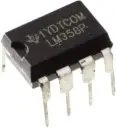
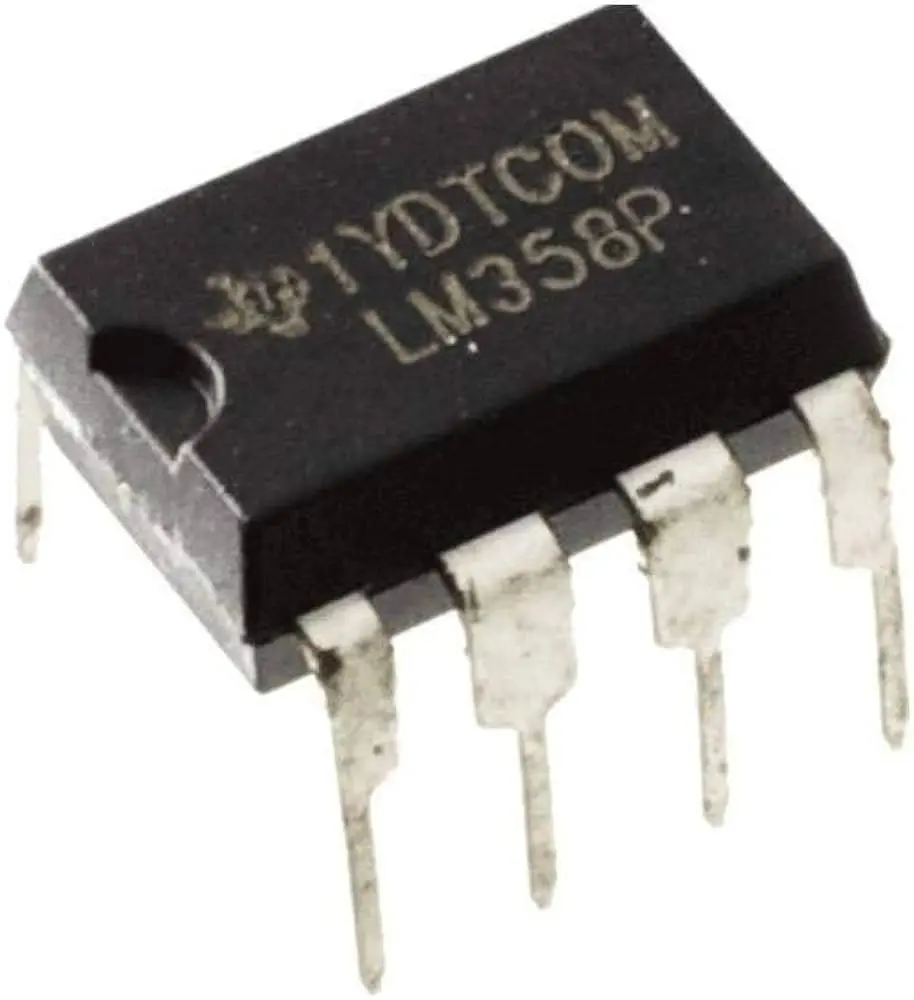
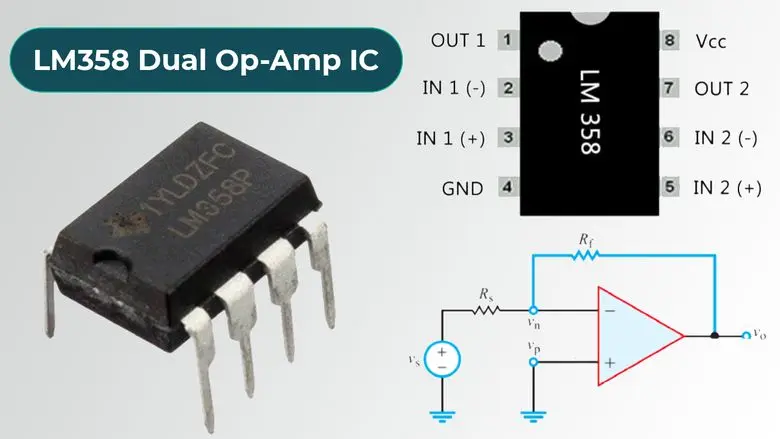
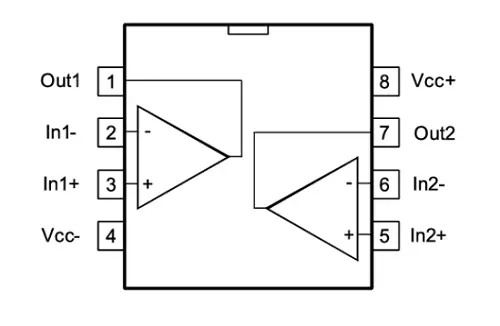
⚙️ LM358 – Dual Low‑Power Operational Amplifier (DIP‑8)
The LM358 is a versatile dual op‑amp featuring wide-range supply operation, low power consumption, and a common-mode input that includes ground, making it ideal for battery-powered systems, sensor amplification, active filters, and interfacing with microcontrollers.
📊 Key Specifications
| Parameter | Typical / Range |
|---|
| Supply Voltage (single‑supply) | 3 V – 32 V ti.com+14onsemi.com+14indianhobbycenter.com+14mouser.com+7diodes.com+7ti.com+7 |
| Supply Current | ~440 µA (per amp) |
| Gain-Bandwidth Product (GBW) | ≈ 1 MHz |
| Input Offset Voltage | ≤ 3 mV (typ), ≤ 5.8 mV (max) |
| Input Bias/Offset Current | ~10 pA / ~20 pA |
| Input Common‑Mode Range | 0 V to (VCC–1.5 V) |
| Output Voltage Swing | 0 V to (VCC–1.5 V) |
| Output Current Capability | ±10 mA source/sink |
| Operating Temperature | 0 °C to +70 °C (commercial version) |
| Package | 8‑pin DIP‑8 / SOIC‑8 |
🔌 Wiring Example: Non‑Inverting Amplifier with Arduino
Circuit Diagram:
CopyEdit
+VCC (e.g., +12 V)
└── Pin 8 (VCC)
LM358:
Pin 3 (IN+) ← Signal (e.g., sensor or micro)
Rf → Pin 1 (OUT)
Rg → Pin 2 (IN−)
└── Pin 4 (GND)
Output (Pin 1) → Voltage divider → Arduino A0 (0–5 V input)
Sample Arduino Sketch:
CopyEdit
const int sensorIn = A0;
void setup(){
Serial.begin(9600);
}
void loop(){
int raw = analogRead(sensorIn);
float volt = raw * (5.0 / 1023.0);
Serial.println(volt);
delay(200);
}
Use this setup to amplify small sensor signals like temperature or photoresistors for clearer Arduino reading.
🧩 Typical Applications
Sensor front-ends (temperature, light, pH)
Active low-pass/high-pass filters and integrators
Voltage follower and buffer stages
Signal summing and differential measurement
Battery-powered instrumentation
▶️ YouTube Tutorials (copy links)
📄 Official Datasheet
Download the full technical datasheet (Onsemi / TI) covering pinout, electrical characteristics, graphs, and application circuits:
LM358 Datasheet PDF