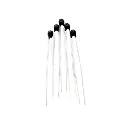
🌡️ Thermistor NTC 10K Ohm – Temperature Sensor (Negative Temperature Coefficient)
The NTC 10K Thermistor is a highly sensitive temperature-sensing resistor whose resistance decreases as temperature increases. It's widely used for temperature measurement, environmental monitoring, battery protection, and Arduino/ESP32 projects. The 10KΩ resistance at 25°C makes it a standard choice for many control and automation systems.
⚙️ Technical Specifications
| Parameter | Specification |
|---|
| Type | NTC (Negative Temperature Coefficient) |
| Nominal Resistance | 10KΩ ±1% @ 25°C |
| B-Value | ~3950K (varies slightly by model) |
| Operating Temp | -40°C to +125°C |
| Material | Epoxy-coated bead type or glass (varies) |
| Lead Type | Radial (through-hole) |
| Response Time | Fast – a few seconds |
✅ Features
🌡️ Highly sensitive to temperature changes
⚙️ Standard 10KΩ resistance – compatible with most microcontrollers
🛠️ Easy to use in analog input circuits with voltage dividers
🔧 Compact, durable, and low-cost temperature sensing solution
💡 Ideal for Arduino, ESP32, Raspberry Pi, or smart HVAC
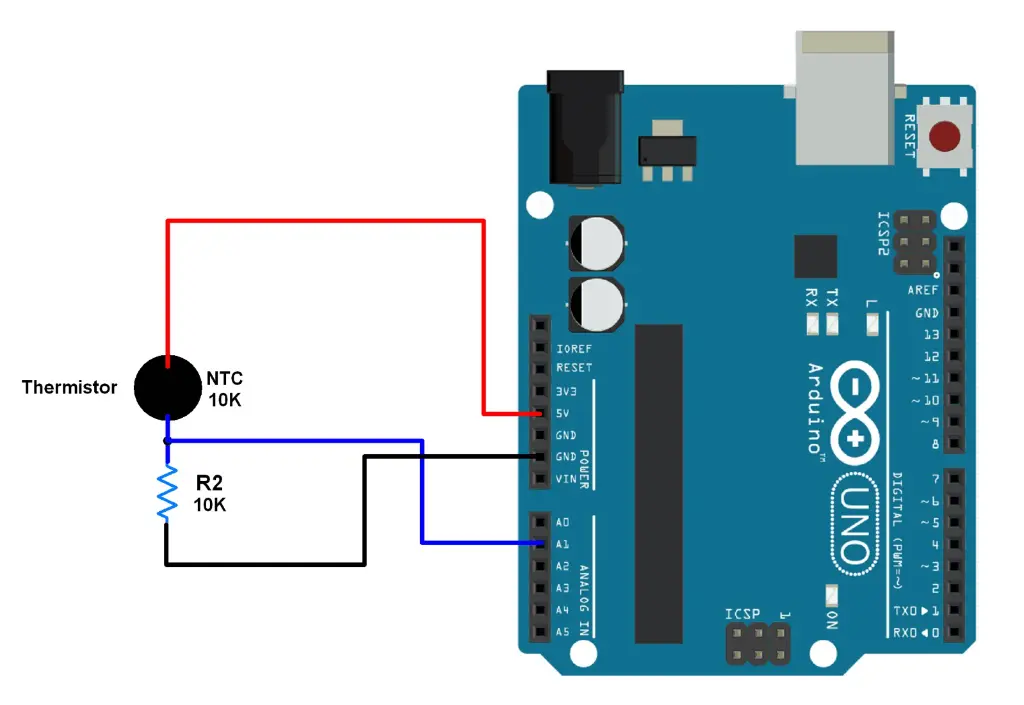
🧠 How to Use with Arduino
Use the thermistor in a voltage divider with a 10K resistor:
 VCC (5V)
   |
  [10K Resistor]
   |
   |--------> A0 (Analog Input)
   |
 [NTC 10K Thermistor]
   |
  GND
🧪 Sample Arduino Code
int thermistorPin = A0;
float R1 = 10000.0; // 10K resistor
float B = 3950;     // B-value
float T0 = 298.15;  // 25°C in Kelvin

void setup() {
  Serial.begin(9600);
}

void loop() {
  int val = analogRead(thermistorPin);
  float R = R1 * (1023.0 / val - 1.0);
  float temperatureK = 1.0 / (1.0/T0 + (1.0/B) * log(R / R1));
  float temperatureC = temperatureK - 273.15;
  Serial.print("Temperature: ");
  Serial.print(temperatureC);
  Serial.println(" °C");
  delay(1000);
}
🎥 YouTube Tutorial
📺 How to Use NTC Thermistor with Arduino